

Identity Revolution
From Assyrians' Identity Tables to Blockchain, a path to foster people's Identification on a global scale

It’s in! The 101 subscriber of the newsletter is in!
Just let me be happy and proud of this for a short while. I started this newsletter a few months ago, and I didn’t expect more than 100 people to subscribe to it. Therefore, let me share this pretty little nice news with y’all! 🎉🎉
Now, without further ado, let’s dive deep into today’s topic: Identification. It may seem a bit odd, but I promise there’s so much technology in this topic that you would never imagine.
Oh, and if you haven’t already, make sure to hit the button bellow to subscribe 👇

A short story of Identification’s Systems
Identification has been a concept for quite a while, dating back to the Assyrians who developed the first identification system called "Identification’s tables," made of fired clay. These were a true, ancient form of the most common ID we now have in our physical wallets (emphasizing the physical aspect, not digital wallets - you'll understand later), quite rudimentary but useful for the needs of the time. A similar, albeit much simpler, approach also occurred during the Roman Empire, where individuals could be identified and recognized as Romans simply by saying "Civis Romanum sum" ("I'm a Roman Citizen").
Many developments occurred up until the 15th Century when safe conducts were introduced, primarily for commercial purposes, guaranteeing merchants recognition in their trading activities. Only in the late 19th century did a full census of the population begin in France and England, giving rise to a first rudimentary form of a passport. On the other hand, passports were already in use in the Ottoman Empire, introduced in 1848 by the Sultan.
This brief history of the evolution of identification brings us to the present day, where most of us have either a National ID card or a passport. Both serve as the means through which we are identified on a centralized and commonly shared standard, whether it be the standard from our country or a globally agreed-upon standard.
However, few of us may know that passports have different "levels of power." The Henley Passport Index, from Henley & Partners, produces a list of passport importance on a global scale, ranking them from the most important to the least important, primarily based on the need for a VISA to enter a country. If you're Italian, keep in mind that your passport is consistently among the top 10 globally, given its strength on a global scale. On top of the Passport, to identify users on a global scale, each country has its own ID system, usually in the form of an ID card. ID cards are meant to identify users with some pretty specific informations as:
Name
Surname
Residence
Born date
Blood type
Every single country has its own system to identify citizens, mainly focusing on a specific set of information that will be used from public and private sectors to identify them. Recently, new systems of digital identifications were launched to make the identification easier for everyone; if you’re in Italy, you may have your own SPID account, so to make your identification easier.
Government stakeholders and regulated companies, particularly those involved in "KYC - Know Your Customer" processes, utilize the term digital identity to reference an individual's real-world identity. This typically involves a credential, like a passport or ID card, issued by a government authority. The credential contains attributes distinguishing one person from another.
For online identification, the eID system is crucial, relying on at least two authentication factors:
Inheritance (biometrics): Auto-identification and liveness checks with facial recognition.
Knowledge: PINs, passwords, or one-time factors (e.g., SMS).
Ownership: Smart cards (e.g., eID cards) or secure elements on smartphones.
Generally speaking, the number of attributes that are tracked so far are pretty low, imposed from a central identification system.
All of the DID methods shared so fare have something in common though:
they only take in consideration few informations, the one choses on a public level
they are mainly centralized, and the identification is proof is held by few actors
they’re mainly tied to every single national regulation
Now, let's delve into today’s topic: what if there were a way to digitally identify users in a decentralized, sovereign manner? This is precisely what Self-Sovereign Identity (SSI) aims to address. Unlike most common Decentralized Identifier (DID) methods, SSI shifts the focus to the end-users and their willingness to share data, primarily relying on what is known as selective disclosure. This doesn’t imply that you can access services without sharing information, but rather, it involves sharing information masked by privacy layers (powered by blockchain) or providing a set of information that doesn’t necessarily include your personally identifiable details.
SSI is closely associated with web3 and blockchain, reintroducing the concept of attributes and amplifying their significance. This novel approach not only offers a fresh identification flow for users, enabling them to share more attributes to establish their identity but also provides companies with the opportunity to define the attributes they desire for their users.
The innovative SSI and Digital Identity approach lead to a scenario similar to the one depicted in this image, sourced from Adrian Dork, CEO and co-founder of LISSI, one of the many SSI solutions in the space:
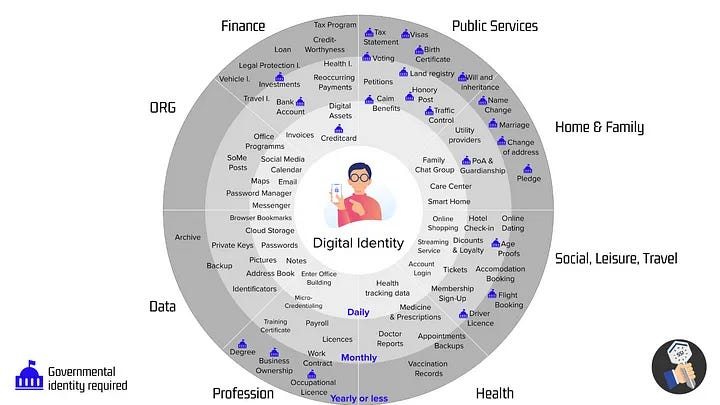
All the identification information you may have in your wallet are governmentally required but will relay even on many other sectors, so to boost the overal experience for the final users.
Still difficult to understand? Let’s make some examples
Imagine a future where you will be able to store all you health information into your wallets, completely masked from a privacy layer. Everytime you do a new medical trial, all the information are recorded there, making it easier for you to have all your medical information stored in just one decentralized wallet
Imagine a future where asking for a loan or a mortgage will be as easy as withdrawing money on an ATM. All your financial informations, financial merit, credits and loans asked in the past are recorded into your Banking ID, making it easier for banks to get all your historical recordings and pass them over for a future credit approval
imagine a place where all your social media interactions are recorded but you only want to share a few of them, not to make your whole social history out there. Yeah, that’s right, making the Social Login more privacy backed and supported. Good right?
Self Sovereign Identity is not just an idea, is becoming slowly and steadily reality in the EU market. The new eIDAS 2 regulation is setting the stage for the launch of the European Digital Identity Wallet, aka the place where all the Digital Identity info will be stored in the future. And this is where we introduce the place where all the attributes and the information of our identities fall: a (potentially) blockchain-based wallet.
Wallet’s won’t just be the places where we’ll store digital assets as bitcoin or ether but, furthermore, will be our touch points for everything in the future. Hospitals, public services, banks and all the other facilities we interact daily will be intertwined through a simple and easy approach, where blockchain acts as a leger, a validator, a decentralization method and a privacy tool.
Future is bright, and the sooner you move away from hype and understand blockchain, the better will be for you to understand how to benefit from it in the future.
Thank you again for staying with me, next week I’ll learn something for you: Artificial Intelligence. I’m pretty basic on this, let’s say that the next one will be an AI 101!
PS: now, if you liked this post, please click on this button and refer my newsletter to a friend! I have some cool perks for top referrers 👇